Priority to Increase Public Involvement in Civic Affairs
City Council's Accomplishments

Dateline 2004 – Open Council and Committees - City Council approved the next phase of the City Clerk’s “Meeting Management Project”. The project’s goals are to ensure the City's decision-making processes are as open and transparent as possible by providing more timely access to information, processes are easier to understand, and new opportunities to participate are created.
More

Dateline December 2003 – 3-1-1 – City Council established a working group to implement 3-1-1 a key initiative of City Council’s Public Service Improvement Priority – this single access phone number will provide a “one-stop” service to the public with quick, accurate information on municipal services and programs and will track public service requests for information and assistance.

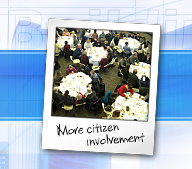
Dateline: January 2004 - Listening to Toronto. - City Council mobilized public interest and involvement in the municipal budget at the first ever Listening to Toronto. 1,200 members of the public participate in 7 sessions helping set the public agenda for this term of City Council. At subsequent sessions (November 2004 and June 2005), participants discussed three City Council Priorities and, in partnership with the Province of Ontario a proposed new City of Toronto Act.
More

Dateline March 2004 - Roundtables on City Issues - City Council adopted terms of reference for six roundtables through which members of the public will contribute their voices to the City's decision-making process on key issues. The roundtables will address access, equity and human rights; arts and culture; the "beautiful city" project; children, youth and education; environment; and seniors.
More
Dateline March 2004 - Integrity Commissioner - City Council established the position of City Integrity Commissioner. The Integrity Commissioner will deal with complaints related to the Code of Conduct for Council, and will provide advice respecting the code and other policies governing the ethical behaviour of City Council members.
More

Dateline September 2004 - Election Reform - City Council adopted recommendations for new rules covering finances in City of Toronto municipal elections. The new rules, which require amendments to provincial legislation in order to take effect, prohibit corporations and unions from contributing money to election campaigns. Among other recommendations adopted are rules for providing more transparent disclosure of campaign finances; increasing the amount of money candidates can spend on their election campaigns (not to include their fundraising expenses within that spending limit); making campaign surpluses the property of the City; and making Elections Ontario responsible for monitoring and enforcing the rules covering election finances.
More

Dateline November 2004 – Public Voices on Council Priorities – Over 700 participants gathered for the second Listening to Toronto session to speak with City Council and the Mayor about City Council's priorities and give advice on how to accomplished three of those priorities - a clean and beautiful city, strengthening public involvement in civic affairs and creating strong neighbourhoods.
More

Dateline October 2005 - Enhancing Toronto’s Business Plan - Public consultations were held during 2004 and 2005 to gather input from businesses and residents to identify ways all stakeholders could work together to address enhancing Toronto’s long-term business strategy, sustainability and competitiveness.
More

Dateline June 2005 – Joint Province/City Consultations – In June the City and the Province held a first-ever joint public consultation on the City of Toronto Act called Strong Toronto, Strong Ontario. Over 700 participants attended four simultaneous sessions, strongly supported the development of a new City of Toronto Act and demanded that Toronto as Canada's fifth largest government should operate under different rules than other municipalities. Participants wanted decisions about the future of their city to remain with their local government and not with a provincially appointed body like the Ontario Municipal Board. They stated that Toronto needs significant additional funding and a better match between the services the City is expected to provide and the revenue sources available for funding those services.
More

Dateline December 2005 – Engaging Research – City Council’s Governing Toronto Panel released its commissioned research on civic engagement which led the Panel to conclude that “although a City Council that reflects the diversity of our city is critical to meeting the imperative of social inclusion, increasing voter turnout and engagement across the city matters just as much….Faith, ethnic, age-related and other community groups all add to the vibrancy of the city. It is critical that we capture and act upon their ideas to build the City we want.”
More

Dateline November 2005 – Public Voices/Governance Choices – 150 members of the public provided their input to the Governing Toronto Advisory Panel on the role of City Council, the Mayor, committees and Community Councils and their ideas on how to enhance public engagement in local decision-making.
More
Dateline June 2005 - Citizen Role in Environmental Assessment - City Council approved plans to assemble a group of Toronto residents to help undertake an environmental assessment of options for dealing with the city's trash that cannot be recycled or composted. The citizen group will work closely with City Council's Works Committee over the next four to six years.

Dateline January 2006 – Budget Consultations – Building on the 2004/2005 Listening to Toronto sessions, the City hosted four public consultation sessions to receive input on the 2006 proposed operating budget. A summary of public comments have been forwarded to Policy and Finance Committee.
More
|







 Perhaps it is time we had zero tolerance for what enfeebles the passionate imagination of a city. What enfeebles it?