Priority to Get the Powers and Funding Needed for Toronto to Succeed
City Council's Accomplishments

December 2003 – Mayor Miller’s Call To Action – Mayor David Miller’s inaugural address called for an alliance of big city mayors to advance an urban agenda in Canada, to show a new kind of leadership in building productive partnerships with Ottawa and with Queen's Park and to create a new deal for Canadian cities.
More
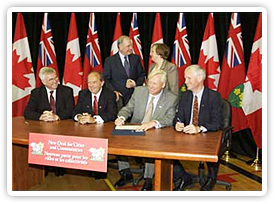 |
June 17, 2005 - Signing the New Deal for Cities
and Communities, Prime Minister Paul Martin
and Mayor of Oakville, Ann Mulvale, (seated, l-r)
Ontario Municipal Affairs and Housing Minister
John Gerretsen, Roger Anderson, President
of the Association of Ontario Municipalities,
Toronto Mayor David Miller and federal
Minister of State (Infrastructure and Communities)
John Godfrey. |

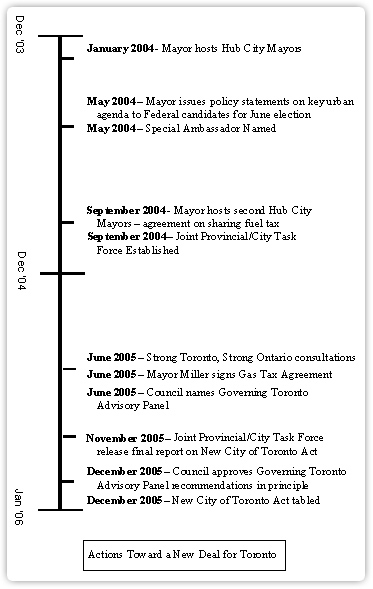
January 2004 – Hub City Mayors Summit - Mayor Miller hosted the first summit of Canada’s hub cities with mayors and representatives from Halifax, Quebec City, Montreal, Ottawa, Winnipeg, Regina, Edmonton, Calgary and Vancouver to plan a strategy for approaching the federal government on funding and support for urban issues.
Dateline January 2004 - Enough of Not Enough: Campaign for a new deal - Council endorsed the Toronto Board of Trade's public relations campaign called Enough of Not Enough. The campaign is a call to action by Toronto residents and businesses to urge their elected members in the federal and provincial governments to take action in support of the city's public transit, affordable housing and waterfront rejuvenation. Council asked Mayor David Miller to encourage the Big City Mayors' Caucus and the Federation of Canadian Municipalities to endorse the campaign.

Dateline March 2004 – Full GST Rebate – The Federal government agreed to full GST rebates for all municipalities in the 2004 federal budget. The 100% GST rebate will be worth almost $50 million each year to Toronto.

Dateline May 2004 – Federal Candidates Put On Notice - Mayor Miller issued policy statements on key urban issues to Federal candidates for June election and sought their commitment to sustainable revenue sources including a portion of the gas tax. Additionally candidates were asked to support direct participation by Toronto in discussions and agreements between the Federal and Provincial governments on matters that directly affect the City, such as transit, immigration, affordable housing and waterfront revitalization.
Dateline May 2004 - John Honderich Named Special Ambassador - Former Toronto Star publisher John Honderich agreed to serve as the Mayor of Toronto's Special Ambassador on the cities agenda for an annual salary of $1.00. Mr. Honderich's duties include supporting City Council's efforts to keep Toronto's position on the New Deal for Cities front and centre, and to enhance the City's relationship with federal and provincial decision makers.
More

Dateline September 2004 – Second Hub City Mayors Summit - A two-day meeting of Canada’s ten hub cities, chaired by Toronto Mayor David Miller, concluded with a clear agreement on a plan for reinvesting in public transit and urban infrastructure, based on swift delivery of the federal fuel (gas and diesel) tax.
Dateline September 2004 – Joint Task Force Established – Premier Dalton McGuinty and Mayor David Miller officially launched a joint Toronto-Ontario review of the City of Toronto Act, 1997 and other private (special) legislation. This was the first step in the creation of a modernized City of Toronto Act. The Task Force released their interim report in May 2005, followed by their final report in November 2005.

Dateline June 2005 – Strong Toronto, Strong Ontario - On June 22, 2005, the City and the Province held a first-ever joint public consultation on the City of Toronto Act called Strong Toronto, Strong Ontario. Over 700 people attended four simultaneous sessions. Participants strongly supported the development of a new City of Toronto Act and demanded that Toronto, as Canada's fifth largest government, should operate under different rules than other municipalities. Participants wanted decisions about the future of their city to remain with their local government and not with a provincially appointed body like the Ontario Municipal Board. And, they stated that Toronto needs significant additional funding and a better match between the services the City is expected to provide and the revenue sources available for funding those services.

Dateline April 2005 –Planning For Toronto’s Future - Council approved a Long-Term Fiscal Plan to guide the City in achieving sustainability through new revenue sources provided by the federal and provincial governments. The plan, which will help the City maintain its strong credit rating, offers strategies for funding assets and liabilities, managing expenditures and enhancing revenues.
More
Dateline June 2005 – City’s Shortfall Confirmed - Council received a report from the Conference Board of Canada confirming Toronto’s fiscal capital and operating shortfall of about $1.1 billion per year, starting in 2006 through to 2025. A Board of Trade study confirmed this challenge stating “a significant mismatch exists between Toronto’s expenditure responsibilities and its revenues sources…”
Dateline June 2005 – A New Way Of Governing - Council established a three-member advisory panel to review the City’s current governance structure and make recommendation on a new governance system for Toronto. The City anticipated receiving new powers and a new legislative framework under a forthcoming new City of Toronto Act. The advisory panel, which consisted of Centennial College president Ann Buller, University of Toronto law professor Sujit Choudhry, and businessman and community leader Martin Connell, led an engagement process to hear from civic leaders, community members and other stakeholders.
More
Dateline June 2005 - Mayor Miller signs Gas Tax Agreement - Toronto became the only city in Canada to sign a direct agreement with the federal government for transit funding through the transfer of federal gas tax revenues under the New Deal for Cities and Communities. By the end of 2010, the agreement is anticipated to generate over $400 million for the City of Toronto.
More
Dateline June 2005 - Mayor Miller signs Transit Funding Agreement in Principle – Toronto signed an Agreement in Principle with the Federal Government to flow an additional $200 million over two years for transit .

Dateline December 2005 – Progress on Governance - City Council gave its approval in principle to the recommendations of the Governing Toronto Advisory Panel and asked the city manager to report on steps required to implement the recommendations. The panel's recommendations include improving civic engagement and community involvement, strengthening Council's ability to focus on city-wide priorities, creating an executive committee to integrate the City's agenda, providing the mayor with tools to lead Council, and empowering community councils. City Council also set up a five-member committee to help the city manager with implementation and requested further public consultation.
More
Dateline December 2005 – New City of Toronto Act Introduced - On December 14, 2005 Bill 53, which creates a modernized City of Toronto Act to bring Toronto’s legislative framework into the twenty-first century was introduced in the Ontario legislature. The legislation is on track to be passed into law in time for the new term of Council. The new City of Toronto Act will provide the City with the tools it needs to achieve a culturally vibrant, economically strong and environmentally sustainable Toronto.
 |
|
 |
|